


The Silkworm Enzyme

Silkworm Butterfly
The Silkworm (Bombyx mori) is the caterpillar of a moth whose cocoon is used to make silk; it is not a worm at all. This insect is also called the silkworm-moth and the mulberry silkworm. It is native to Northern China.
Carpal tunnel syndrome
Twenty patients with carpal tunnel syndrome (CTS) were evaluated clinically, and treated with 10 mg serratiopeptidase twice daily for six weeks with an initial short course of nimesulide (a COX-2 inhibitor). The results were that 65% of cases showed significant clinical improvement which was supported by significant improvement in electrophysiological parameters.[45]
Inflammatory venous diseases
Patients with thrombophlebitis were treated with 5 mg tablets, at a dose of 30 mg serrapeptase daily (two 5 mg tabs, three times daily) for 14 days. By the end of treatment spontaneous pain was reduced 63.3% from the baseline mean score. Pain on pressure was reduced 57.6%. Edema was reduced 56.2%; erythema (redness of skin) diminished 58.3%; nighttime cramps were 52.9% less; hemorrhagic suffusion was 41.7% less (from 1.2 to 0.7); cutaneous dystrophy (skin wasting) was reduced by 7.7%. At the end of the treatment with serrapeptase, efficacy was assessed as good or excellent in 65% of the cases.[46]
Breast engorgement
Seventy patients complaining of breast engorgement were treated with serrapeptase or placebo for three days. The results were that serrapeptase was superior to placebo for improvement of breast pain, breast swelling and induration (tissue hardening), with 85.7% of the patients experiencing “moderate to marked” improvement compared to 60.0% in the placebo group. Furthermore, “marked” improvement was found in 22.9% of the serrapeptase group compared to 2.9% of the placebo group.[47]
Bronchitis
Preliminary evidence suggests that patients with chronic bronchitis or bronchiectasis who take serrapeptase 30 mg daily for 4 weeks have significantly reduced frequency of cough and expectoration. These patients who took serrapeptase also seem to have decreased sputum viscosity and lower neutrophil counts in sputum samples.[48] Similar beneficial results were demonstrated in animal research.[49]
Chronic pulmonary disease
Forty patients with chronic pulmonary disease were treated with expectorants to determine the effect on sputum viscoelasticity. Patients were randomly put into the control group or a group which would be given oral treatments with an expectorant for a week after a one week washout period. The groups were as follows: Group I, control; Group II, Bromhexine hydrochloride 24 mg per day; Group III, Ambroxol 90 mg per day; Group IV alpha – Chymotrypsin buccle 100 ch.u. per day; Group V, Serratiopeptidase 30 mg per day. The results were that the sputum viscoelasticity in the serrapeptase and chymotrypsin groups were clearly changed after the treatments, with the magnitude of the sputem relaxation and its main relaxation time were significantly increased. No significant changes were observed in the other groups. These findings suggest that proteolytic enzymes administered orally work on the molecular structure of sputum, and break down their linkages between subunits of the structure.[50]
Laryngitis
Research demonstrated that patients with laryngitis who take serrapeptase 10 mg three times daily have significantly reduced pain, secretions, difficulty swallowing, and body temperature after 3-4 days of treatment.[51]
Serrapeptase liposomes
Research indicates that in comparison with pure serrapeptase, incorporation of serrapeptase into liposomes improved permeability, and thus it could be concluded that the liposomal formulation would improve the oral absorption of enzyme.[56]
How Does Serrapeptase Work?
Serrapeptase reduces pain and inflammation in three different ways:
- Serrapeptase breaks down fibrin, and important protein in the blood that is involved in blood coagulation or clotting.
- Serrapeptase thins the fluids associated with inflammation. This allows fast drainage which leads to quicker recovery times after injury or surgery.
- And finally, Serrapeptase elliminates pain by blocking the release of Bradykinin in damaged tissue. Bradykin is a protein responsible for triggering a pain response.
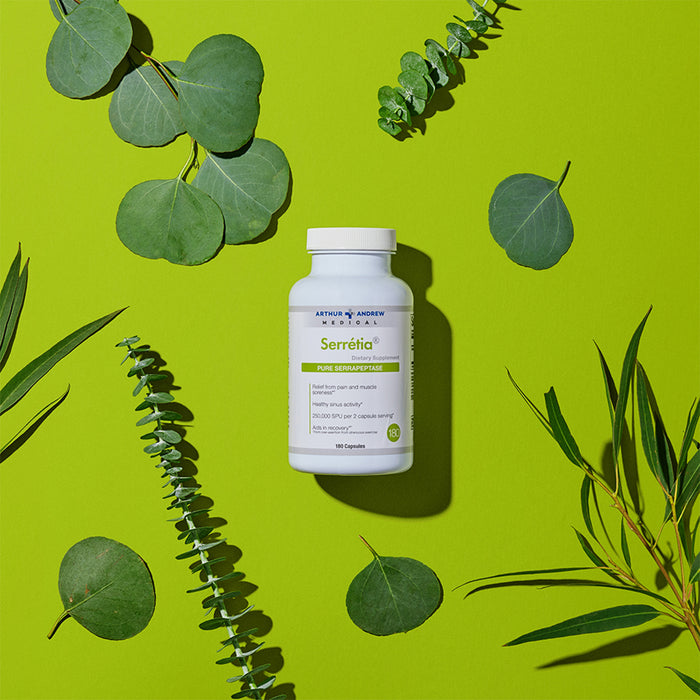
Serrapeptase
Serrapeptase has been shown in in-vivo research to be absorbed from the gastrointestinal tract when taken orally. It has anti-inflammatory, antiedemic, and fibrinolytic effects as well as decreasing pain?apparently by inhibiting the release of bradykinin and other factors from inflamed or damaged tissue. Research has demonstrated serrapeptase anti-inflammatory effects in such conditions as post-operative swelling, pharyngitis, sinusitis, and others. In addition, serrapeptase helps to help break down proteinaceous secretions and therefore facilitate the elimination of excessive secretions. For example, serrapeptase has decreased sputum viscosity and decrease neutrophils in the sputum of patients with chronic airway disease. Also, serrapeptase has antibacterial properties, and a synergistic relationship with antiobiotics, helping to disperse them more effectively throughout tissues.
Post-operative swelling/pain/edema
Patients undergoing maxillary antrotomy for empyema who take serrapeptase 10 mg orally three times on the day before surgery, once in evening after surgery, and three times daily for 5 days after surgery seem to have modestly reduced buccal swelling compared to placebo.
Patients undergoing surgical removal of impacted third molars were randomly sorted to receive ibuprofen, paracetamol, betamethasone, serrapeptase or placebo. Serrapeptase did not show significant analgesic and anti-inflammatory action. However, in a similar study of patients undergoing surgical removal of impacted third molars, 5 mg serrapeptase 5mg or placebo was given with 1000 mg paracetamol. There was a significant reduction in the extent of cheek swelling and pain intensity in the serrapeptase group at the 2nd, 3rd and 7th postoperative days.
Preventive edema protection using Serrapeptase after standardized one-stage osteotomy procedures of 4 third molars was verified by means of an opto-electronic measuring instrument. This measuring technique proved to be a sensitive tool for demonstrating the efficacy of
In other research serrapeptase demonstrated statistically significant effectiveness in reducing postoperative edema in patients undergoing the removal of 4 third molars.[36]
Sixty-six patients, who underwent surgical treatment of the lateral ligament, were treated with elevation of the leg, bed rest (with and without the application of ice) or serrapeptase. In the serrapeptase group, the swelling had decreased by 50% on the third post-operative day, while in the other two control groups no reduction in swelling had occurred at that time. Decreasing pain correlated for the most part with the reduction in swelling. Thus, the patients receiving the test substance more rapidly became pain-free than did the control groups.[37]
Parflex, a single pharmaceutical product combining aceclofenac with paracetamol and serrapeptase, was assessed in management of pain and inflammation in adult patients undergoing ENT, orthopedic or gynecologic surgical procedures. Effectiveness was rated as excellent or good by 54% of patients and by 59% of treating physicians. The conclusion was that parflex is an effective analgesic, anti-inflammatory drug that has a valuable therapeutic option for controlling pain and inflammation after surgical procedures.[38]
Antibacterial treatment
Listeria monocytogenes is a notably invasive bacterium associated with life-threatening food-borne disease in humans. Several surface proteins (biofilms) have been shown to be essential in the adhesion of L. monocytogenes, and in the subsequent invasion of phagocytes. In research, treatment with serrapeptase reduced the ability of L. monocytogenes to form biofilms and to invade host cells in the human gut.[39]
In an animal model, bacterial infections associated with knee surgery were treated with either serrapeptase + antibiotic, antibiotic only, or nothing. At two weeks, Microbiological testing suggested that infection existed in 63.2% of animals in the no-treatment group, 37.5% of animals in the antibiotic-only group, and only 5.6% of animals in the serrapeptase + antibiotic group. Researchers concluded that serrapeptase was effective at eradicating infection caused by biofilm-forming bacteria.[40]
Other research has also demonstrated the effectiveness of serrapeptase at inhibiting biofilm-embedded bacteria in prosthetic device infections. [41]
Cephalosporin antibiotics are widely used to prevent infection in patients undergoing thoracotomy. Augmentation by serrapeptase on tissue permeation of the cephalosporin Cefotiam (CTM) was examined in 35 thoracotomy patients with lung cancer. The subjects were divided into two groups, one receiving a single dose CTM alone, the other receiving a combination of CTM and serrapeptase (30 mg daily) for three days before surgery. The results were the concentration of the drug in pulmonary tissues was 29.1% in the single dose group, and 44.2% in the combination group. The researchers concluded serrapeptase stimulated permeation of the antibiotic into tissues.[42] Similar beneficial effects on the distribution of antibiotics in tissues with serrapeptase were seen in other human[43] and animal[44] research.
Pharyngitis
Research demonstrated that patients with pharyngitis who take serrapeptase 10 mg three times daily have significantly reduced pain, secretions, difficulty swallowing, and body temperature after 3-4 days of treatment.[52]
Sinusitis
Serrapeptase was found to improve the flow properties of nasal mucus secretions in adult chronic sinusitis patients.[53] When 30 mg serrapeptase daily was administered to adult patients with chronic sinusitis for 4 weeks, the viscosity of nasal mucus was reduced.[54] Research has shown that patients with sinusitis who take serrapeptase 10 mg three times daily also have significantly reduced pain, nasal secretions, nasal obstruction, and anosmia (lack of sense of smell) after 3-4 days of treatment.[55]